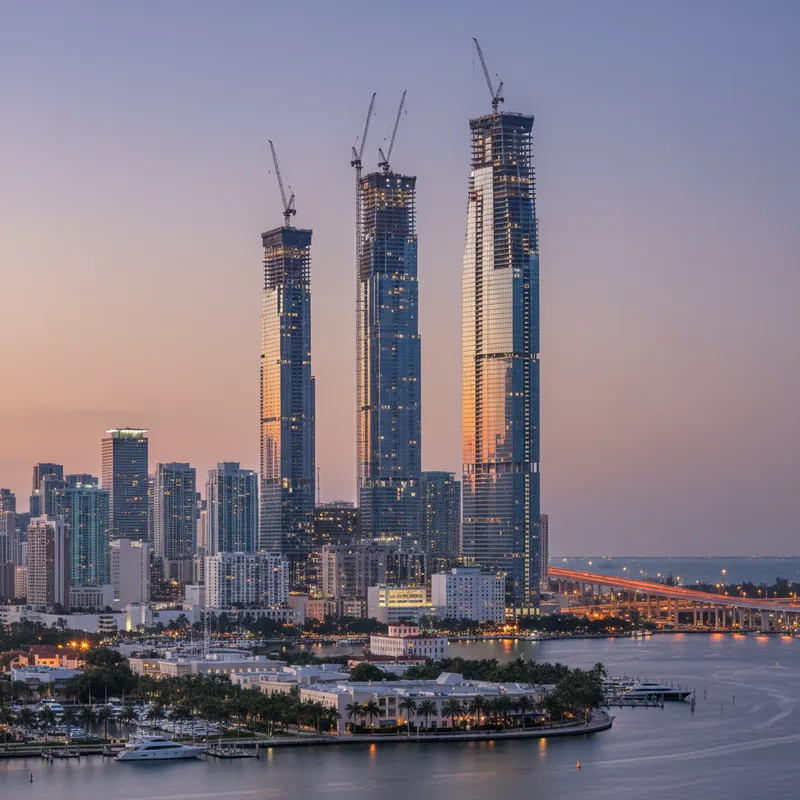
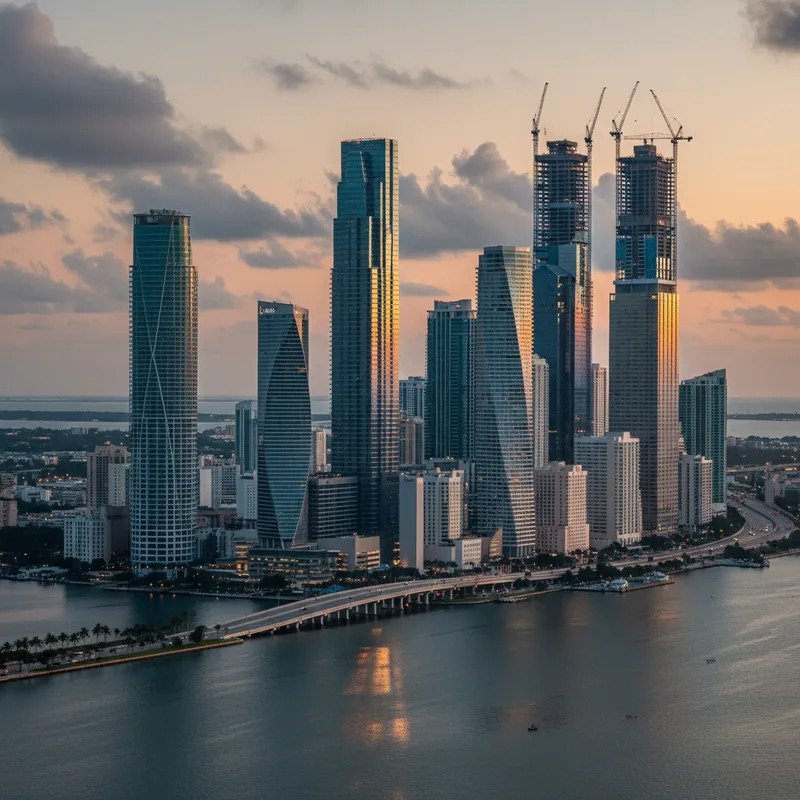
Miami's horizon is on the verge of a dramatic and historic transformation. A wave of new skyscrapers, designated as "supertall" for exceeding 984 feet, is set to begin reshaping the city's famous skyline, pushing architectural limits and cementing Miami's ambition as a top-tier global city.
Leading the charge is the Waldorf Astoria Hotel & Residences Miami, a monumental 100-story tower that will be the city's first supertall. Designed to resemble a stack of unevenly placed glass cubes, the building will climb to a height of 1,049 feet. Its completion, expected in 2028, will mark a new chapter for development in downtown Miami, far surpassing the city's current tallest building, the 868-foot Panorama Tower in Brickell.
The Waldorf Astoria, however, will not stand alone for long. It is just the first in a parade of towering structures planned for the city’s urban core. This surge in vertical growth reflects a booming demand for luxury real estate and a concerted effort by developers to make an indelible mark on the city's architectural identity.
A skyline reshaped by ambition
The race to the sky includes several other significant projects. Ken Griffin's Citadel has already broken ground for its new global headquarters, a 1,049-foot tower that will match the Waldorf Astoria in height. PMG, the developer behind the Waldorf, is also planning the 985-foot Delano Residences Miami nearby, a hotel and condominium tower expected to be finished in 2030. Christian Tupper, vice president of sales for PMG Residential, says the two towers are designed to complement each other in the new skyline.
Other proposed projects aiming to break the 1,000-foot barrier include One Bayfront Plaza, Regalia on the Bay, Miami Riverbridge, and 888 Brickell by Dolce & Gabbana. Even those falling just short of supertall status will have a major impact, like the Okan Tower. Currently under construction, the 902-foot, 70-story building is the Turkish developer Okan Group's first U.S. project. Its head of sales, Michael Sadov, notes its unique design was inspired by the tulip, Turkey's national flower.
This kind of distinctive architecture has become a key part of the development strategy. Developers are not just building residential and commercial space; they are creating landmarks. Eric Firley, a professor of architecture at the University of Miami, explains that these eye-catching skyscrapers are an act of branding for both the developer and the city itself, helping to drive tourism and signal a city’s status as an important international hub.
It’s great for the city. The more supertalls, the better. A lot of them have beautiful architecture. It helps to define a skyline.</blockquote>
The challenges of building upward
Constructing these giants is a feat of engineering, finance, and planning, and it comes with a unique set of challenges. In Miami, one of the most significant constraints is a federal one. The Federal Aviation Administration (FAA) has set a maximum height of 1,049 feet for buildings in parts of downtown and Brickell to ensure safe flight paths for planes using Miami International Airport. Both the Waldorf Astoria and the Citadel tower are being built to this absolute limit, effectively making them the tallest possible structures in the area.
Beyond regulatory hurdles, the practicalities of construction are immensely complex. As PMG's managing partner Ryan Shear points out, building supertalls is expensive and slow, often taking twice as long as shorter skyscrapers. Strong winds are a constant concern, with safety protocols requiring cranes to shut down at speeds of 35 mph, a frequent occurrence in coastal Miami.
Urban planners also caution that a dense cluster of massive towers requires careful integration at the ground level to avoid creating sterile, windswept canyons. They emphasize the need for street-level shops, restaurants, and public spaces to foster a vibrant urban environment. To mitigate the inevitable increase in traffic, new developments must be built near transit hubs. Fortunately, several of the planned towers are strategically located near the downtown Brightline station and Metrorail, a crucial factor as Miami-Dade home sales climb and the population density increases.
Miami's ascending global status
This construction boom is about more than just adding housing and office space. It’s a powerful statement about Miami’s evolution. The city already boasts the third-most skyscrapers in the United States, behind only New York and Chicago. The addition of multiple supertalls, a category defined by the Council on Tall Buildings and Urban Habitat as buildings over 300 meters, elevates it into a new architectural league. Developer pushes condo tower plan adds to this building trend.
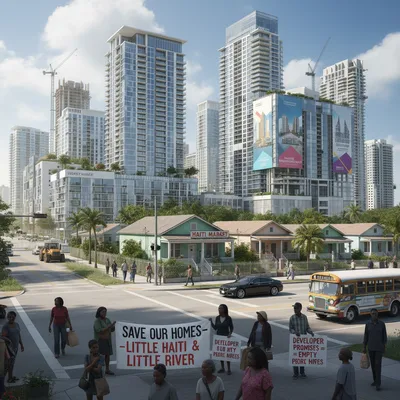
Developers say this wave of construction is a direct response to the soaring demand for “aspirational” luxury real estate in a city that is increasingly attracting international wealth and talent. These towers are symbols that, like the new Te Kaha stadium in Christchurch, signal renewal and a city's forward-looking vision. However, the focus on the high-end market has also drawn attention to the city's broader housing needs, with community advocates recently pressing leaders for more action on affordable housing and mental health services.
The collective vision is one of a re-energized, 24-hour urban core defined by a world-class skyline. These new buildings are not just changing the view; they are altering the very fabric of the city, reflecting its economic dynamism and its claim as a permanent fixture among the world’s most important metropolitan centers.
As these colossal structures rise, they will offer new perspectives on the city itself. In a gesture towards public access, the planned Delano tower will include Miami's first public observation deck, promising residents and visitors a stunning new vantage point from which to view the rapidly evolving city.