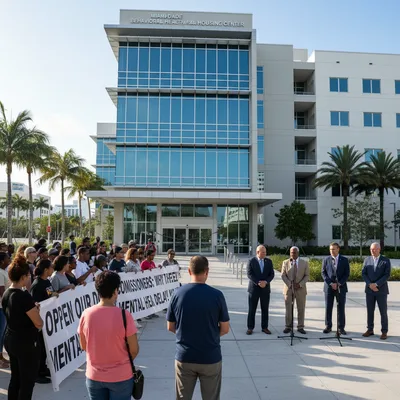
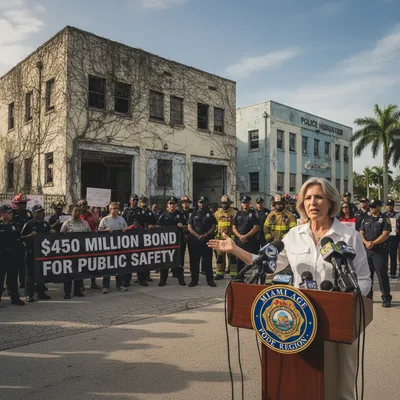
Nearly 800 Miami-Dade residents packed into Corpus Christi Catholic Church on Monday night, securing commitments from county leaders to address the long-stalled opening of a new mental health center and to overhaul the county’s definition of affordable housing.
The assembly, known as the Nehemiah Action, was organized by People Acting for Community Together (PACT), one of the area's most influential interfaith, community-led organizations. The annual event serves as a platform for residents to directly engage with elected officials on pressing social issues, holding them accountable for campaign promises and community needs.
PACT, founded in 1988, has grown to represent over 50,000 people from various churches, synagogues, and mosques, making it one of the largest grassroots organizations in South Florida. Its leaders frame their work as a moral and civic duty.
“That mission is to love our neighbor as we love ourselves. We are living out our faith and putting our beliefs into motion,” said Rev. Sherlain Stevens, PACT president and lead pastor at Ebenezer United Methodist Church. “Democracy is not a spectator’s sport, it requires our participation. It requires courage. It requires perseverance, it requires all of us.”
Officials commit to action on stalled projects
After pssionate testimonies from residents struggling with soaring rents and a lack of mental health resources, the elected officials in attendance made public pledges to support solutions developed by PACT.
This progress would not have been possible if we didn’t come together tonight and show our people power. We continue our push to keep families whole and communities representative of the people who live in them. We continue to push for the support services that Miami-Dade residents deserve.
Miami-Dade County Mayor Daniella Levine Cava, along with Commissioners Ralph “Rafael” Rosado and Oliver G. Gilbert, agreed to support the opening of the Miami Center for Mental Health and Recovery with a nonprofit operator. The commitment marks a significant step forward for the facility, which has been fully constructed but remains shuttered pending county approval.
On the issue of affordable housing, a broader consensus was reached. Mayor Levine Cava, Commissioners Rosado, Gilbert, and Raquel Regalado, as well as Miami-Dade County Housing & Community Development Director Nathan Kogan, largely agreed to support legislation that would redefine income requirements for "workforce housing" and create new incentives for developers. Commission Gilbert was the only official to express a reservation, disagreeing with the proposed 90-day timeline but committing to a six-month window for action.
The unified front from local government was a direct result of PACT’s months-long research, which included listening sessions with community members and consultations with policy experts.
‘The county broke that promise’

A central focus of the night was the long-delayed mental health facility, a seven-story building designed to be an all-encompassing resource for those with mental illness. While affordable housing remains a top concern, PACT leaders emphasized that for the roughly 1,000 chronically homeless individuals with mental illness in Miami-Dade, housing alone is not enough.
The Miami Center for Mental Health and Recovery, which underwent a $51 million county-funded renovation, is designed to provide mental and dental care, job training, and transitional housing. Its continued closure has been a source of intense frustration for advocates who see it as a critical tool to reduce the county's jail population. The Miami-Dade County jail has become the de facto largest psychiatric facility in Florida, costing taxpayers $1.1 million per day, according to Judge Steven Leifman, finance chair of the Homeless Trust.
In a powerful testimony, community lawyer Adam Saper shared the story of his client, Jordan, who he said could have been saved by the center. After a decade in prison, Jordan died by suicide. “He was supposed to receive care. We made a promise to Jordan. The county broke that promise and Jordan paid the ultimate price,” Saper said. “Every day the county delays, someone like Jordan pays the price.”
The delay has been attributed to commission disagreements over the proposed nonprofit operator and budget concerns after initial funding runs out. A competing proposal from a for-profit provider has further complicated the decision. Mayor Levine Cava expressed her eagerness to open the center under the nonprofit model but noted the final decision rests with the county commission.
Redefining housing affordability for Miami’s workforce
The assembly also confronted the county’s growing housing crisis, arguing that the term “workforce housing” has become a misnomer. PACT’s research revealed that the current program, intended for individuals earning between 60% and 140% of the Area Median Income (AMI), is out of reach for many essential workers. The presence of over 40,000 millionaires and billionaires in Miami-Dade significantly skews the AMI upward, a problem exacerbated by the region's status as a southern "Boom Belt" attracting high-earning transplants. Similar issues of affordability and stolen vehicles have surfaced in Ōtara, New Zealand, where a teenager died after a stolen car hit a house.
According to PACT, 140% of the AMI equates to an annual income of $121,000 for a single person. By contrast, the average salary for a Miami-Dade teacher is just $51,000. Under current rules, developers receiving tax subsidies can charge over $3,000 per month for a "workforce" unit, whereas a truly affordable rent for a teacher would be closer to $1,420.
The issue resonates with ongoing struggles for affordability across the county, including efforts by some, like a Miami restaurateur building apartments for his staff, to find private solutions. In response to the testimony, the attending officials agreed to explore incorporating neighborhood-level income data into affordability calculations. “We’ve gotta dig deeper, we gotta do better on subsidies and all kinds of assistance,” said Commissioner Rosado.
The success of community-led pressure campaigns in securing agreements with public officials is not unique to Miami. In California, for example, a last-minute deal was recently reached between the Los Angeles school district and its support staff following organized protests. The willingness of Miami-Dade officials to publicly commit to PACT's proposals signals a recognition of the group’s significant community influence.
With a six-month timeline now established for re-evaluating the county's housing strategy and a renewed push to open the mental health center, advocates are cautiously optimistic. The commitments made at the Nehemiah Action represent a critical turning point, but residents and PACT leaders have pledged to continue their oversight to ensure these promises are kept.