The Miami Gardens City Council has blocked a controversial warehouse development, siding with residents who mounted a fierce campaign against the project over traffic, pollution, and public health concerns. In a 4-3 vote last Wednesday, the council denied a rezoning request from El Dorado Furniture that would have converted a 4.21-acre residential parcel near the Venetian Gardens neighborhood to heavy industrial use.
The vote marked a significant victory for community organizers who for weeks argued that the proposed expansion of the company's existing warehouse facility would endanger their community. The decision followed a lengthy public hearing where residents pleaded with the council to prioritize their well-being over corporate interests.
Voting against the ordinance were Vice Mayor Robert Stephens III, Councilman Reggie Leon, and Councilwomen Katrina Baskin and Dr. Michelle Powell. Mayor Rodney Harris, along with Councilwomen Linda Julien and Katrina Wilson, whose district includes the area, voted in favor of the rezoning. The split vote highlighted the deep divisions in the city over the path of future development.
Residents cite traffic and safety fears
At the heart of the community's opposition were fears that the warehouse expansion would exacerbate already dangerous traffic conditions. Residents described a daily flood of vehicles cutting through their neighborhood, creating a hazardous environment for children and families. They argued that adding more industrial activity would inevitably lead to more trucks and congestion.
Myya Passmore, a Venetian Gardens resident and a key organizer against the plan, told The Miami Times about the constant danger. "Within the last two weeks, we’ve experienced about seven accidents caused by cut-through traffic that comes through the residential area," Passmore said. "We’ve seen two hit-and-runs and two cars that hit homes and a gate." She noted that large trucks already struggle to navigate turns on Northwest 42nd Avenue, causing frequent traffic disruptions.
Representatives for El Dorado Furniture attempted to quell these fears, presenting a traffic analysis that concluded the expansion would not generate a significant increase in trips. Bill Pfeffer of Bowman Consulting, the firm representing the applicant, said the expansion was intended to improve internal circulation, not increase the volume of shipments. He stated the project would add only "seven peak hour trips" based on industry standards and that no new driveway access would be created on Northwest 44th Court.
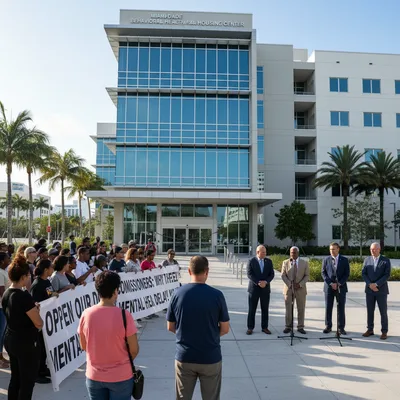
The developer also agreed to several conditions, including adding a landscaped buffer wall, connecting sidewalks, and relocating commercial vehicle areas away from homes. However, these concessions failed to persuade a majority of the council or the residents in attendance, who held signs with messages like "Let our people breathe."

Health and environmental justice concerns
The debate extended beyond traffic, with residents and health experts raising alarms about the potential for increased air pollution in the predominantly Black community. They argued that the city had a responsibility to consider the cumulative environmental impact of industrial zoning on residents' health.
Z Spicer, a community organizer with the climate justice group Catalyst Miami, questioned the validity of the developer's traffic analysis. "Although we heard from the consultants that allegedly there's going to be no increased traffic at this location with the rezoning, we can't say for sure that that's the case," Spicer said.
This is our health. No traffic study has been done, and it comes off a bit biased because they're doing their own studies saying what won't happen. If you’re not tracking [air quality and traffic], and you’re just giving a nice PowerPoint, how are we really assessing how this will impact us?
The potential health consequences were laid bare by Dr. Cheryl Holder, founder of Florida Clinicians for Climate Action. She urged the council to recognize the danger of diesel exhaust from trucks, which releases fine particulate matter known as PM2.5. This type of pollution is linked to severe health problems, including asthma, lung disease, heart attacks, and developmental issues in children.
"Where you live, work and play is more impactful for your health than your DNA," Holder told the council, emphasizing the disproportionate burden of pollution faced by minority communities. Her testimony framed the rezoning request not just as a local land-use issue, but as a matter of environmental justice. Developments like these often parallel other projects in Miami-Dade County, such as activism surrounding a planned $60 million affordable housing hub in Liberty City, where community health is a central concern. Meanwhile, in Tacoma, the city council enters negotiations with Hyun Kim for city manager.
A community's victory
The council's final vote was a culmination of weeks of relentless community organizing. Residents collected petitions, attended meetings, and made their voices heard, ultimately swaying four council members to their side. The decision reflects a growing trend in communities across the nation demanding a greater say in development projects that directly affect their quality of life.
The US Environmental Protection Agency has extensively documented the dangers of particulate matter pollution, noting that it can have serious effects on the heart and lungs. For the residents of Miami Gardens, these were not abstract risks but immediate threats to their families and their future.
While the developer may seek other avenues for expansion, the vote sends a clear message that industrial encroachment into residential areas will face determined opposition. The outcome ensures that, for now, the 4.21-acre parcel will remain zoned for single-family homes. As Dr. Holder noted in her address to the council, the long-term health of the community is intrinsically tied to the decisions made about its environment.