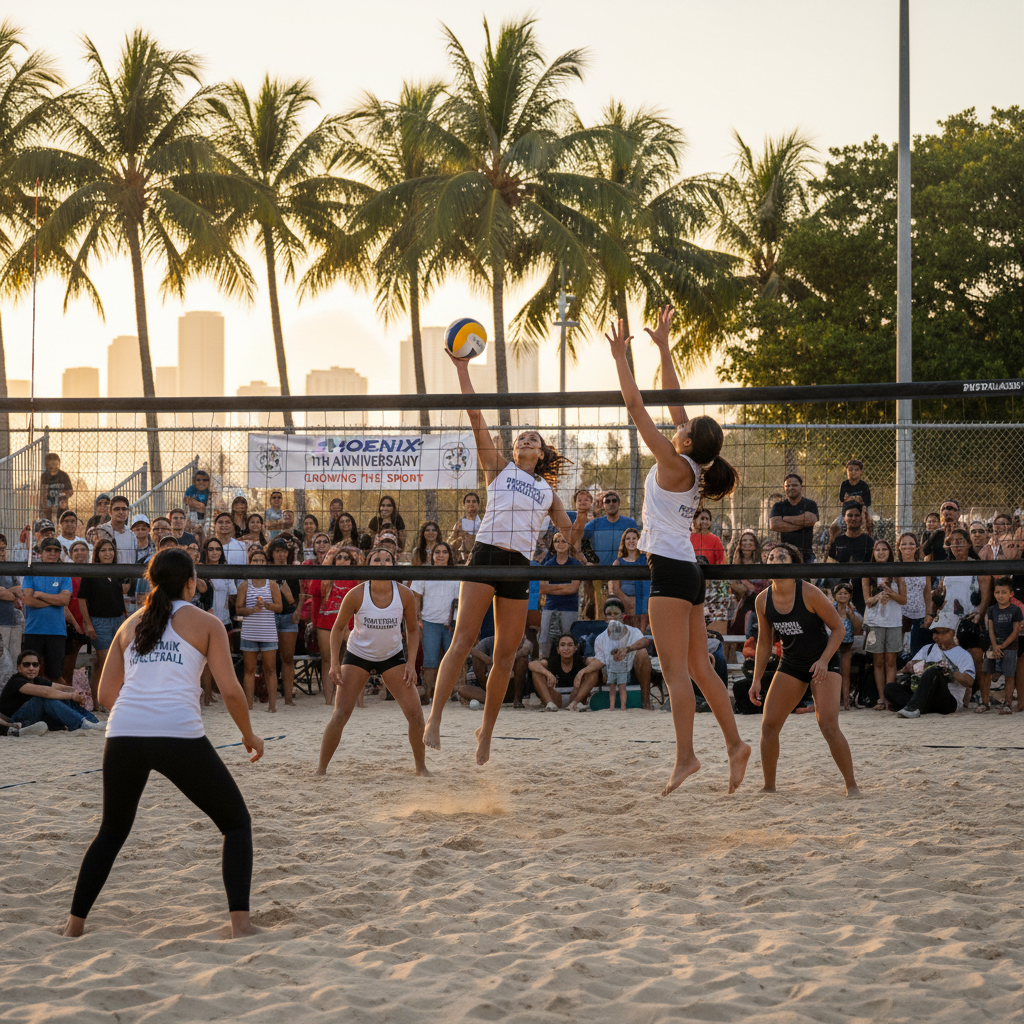
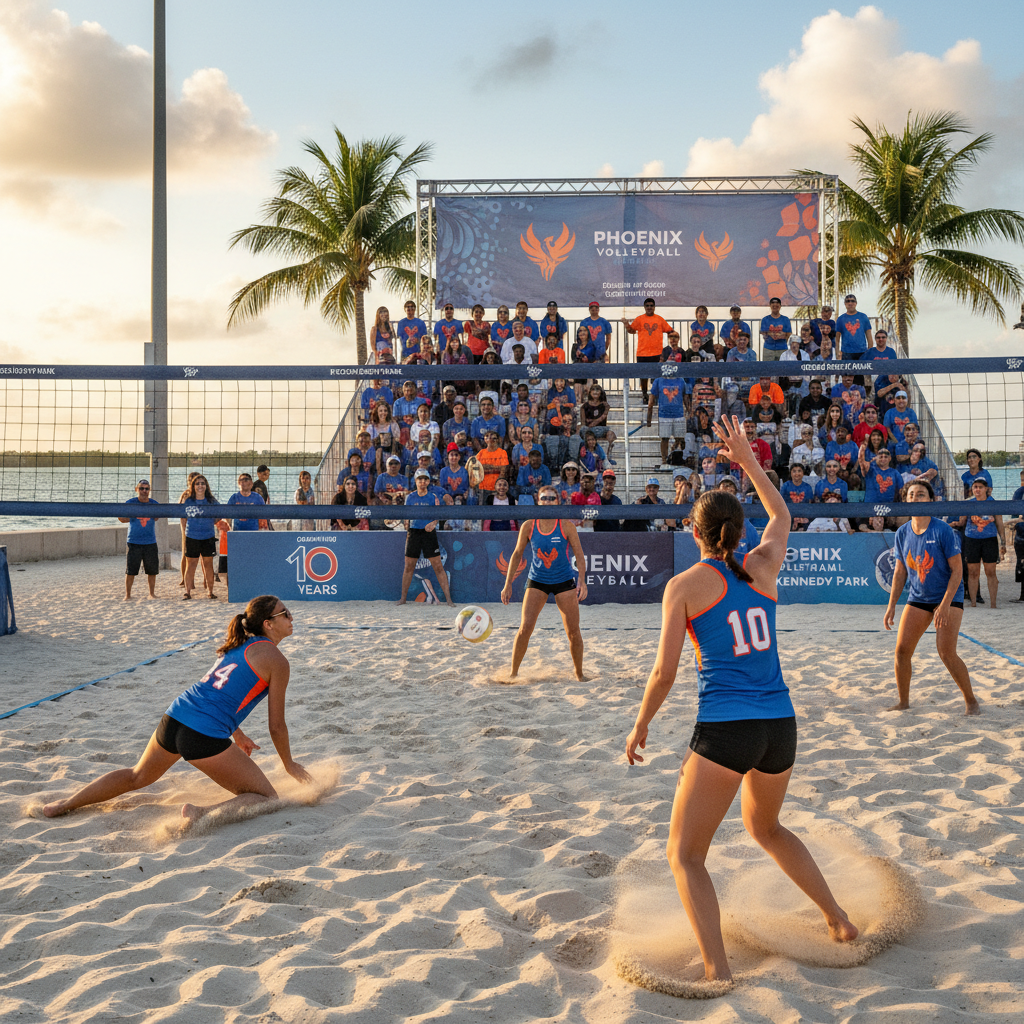
On most evenings in Coconut Grove’s Kennedy Park, the unmistakable sounds of competitive sport fill the air. Under bright lights, players dive across the sand, calling out to teammates and honing their skills as coaches guide them through drills. The sand volleyball courts have become a vibrant hub of activity, drawing athletes of all ages, from elementary school students to adult recreational players. This scene, now a staple of the park, is a testament to a decade of community building and advocacy, much of it driven by Phoenix Volleyball Miami.
This year, the club celebrates its 10th anniversary, marking a milestone for what began as a small program for aspiring athletes. Founded in 2016 by Josh D’Alemberte, Phoenix Volleyball has grown into one of Miami-Dade’s longest-running beach volleyball clubs, leaving an indelible mark on the sport in South Florida and helping to transform the public facilities where the community plays.
The club’s origins are rooted in a desire to create opportunity. D’Alemberte, a longtime coach, saw a need for a different pathway for young players who may have been overlooked by traditional school teams.
“I would see girls try out for their middle school or high school teams and come away disappointed because they didn’t make it,” D’Alemberte said. “I thought, if you trained for a year in beach volleyball, you’d come back stronger. That’s where the name Phoenix came from. rising out of the ashes after something doesn’t go your way.”
A catalyst for community and change
A decade ago, the beach volleyball scene in Coconut Grove was a fraction of what it is today. The courts at Kennedy Park, a sprawling 20-acre waterfront green space, were unlit, meaning play was restricted to daylight hours. This severely limited access for students and working adults, especially during the shorter days of the year.
Phoenix Volleyball became a key advocate for improving these public spaces. The organization’s growth mirrored a broader push from the local volleyball community for better facilities. A major breakthrough came in 2019 when, after years of requests, the City of Miami approved the installation of lights around the Kennedy Park courts.
The decision was not without debate. Some nearby residents raised concerns about potential increases in traffic, noise, and light pollution spilling into their neighborhood. However, city officials ultimately landed on a compromise, restricting nighttime activity to the southern end of the park where the courts are located. The lights, which are programmed to turn off automatically at 10 p.m., revolutionized the park’s atmosphere.
“The lights transformed Kennedy Park and transformed the volleyball community down here,” D’Alemberte said. “When the city builds good facilities, people use them.”
More than just a game
Beyond facility upgrades, Phoenix Volleyball played a part in the successful effort to have beach volleyball officially recognized as a varsity sport by the Florida High School Athletic Association (FHSAA). This effort culminated in the inaugural FHSAA Beach Volleyball State Championships in 2022, cementing the sport’s legitimacy and creating new scholarship opportunities for student-athletes.
For Angela Brown, who joined Phoenix as a coach and is now a co-owner with D’Alemberte, the club’s mission has always been about more than just athletic achievement. It’s about creating a positive and stable environment for children to thrive.
“Sports were one of my guiding forces growing up,” Brown says. “I realized that at an early age, and I wanted to continue providing that for other kids.”
In an era where youth sports can be intensely competitive and financially demanding, a pressure felt by many families as detailed in analyses of the cost of living in Miami, Phoenix aims to offer a different experience. The club focuses on holistic development and community over a win-at-all-costs mentality.
We’re providing a stable place where kids can learn the game, grow, and meet people. In some ways, we’re resisting some of the craziness in youth sports and focusing on what’s best for the kids.
A tight-knit family
Phoenix now operates both beach and indoor programs across Miami-Dade, including an indoor league on Key Biscayne with about 168 participants. Its coaching staff, which fluctuates but currently sits at around 10 active coaches, is the backbone of the organization.
Coach Carlos Rodriguez first connected with the club as an adult player at Kennedy Park before being drawn into its mission. He attributes the club’s success to its strong sense of community.
Rodriguez, who has mentored some players since they were in elementary school, emphasizes teaching life lessons that apply far beyond the sand court. “One of the things we always preach is focusing on what you can control,” he said. “In life, a lot of things won’t go your way, but you can always control your effort, your attitude, and your communication.”
Developing players and people
The impact of that philosophy is evident in the players themselves. Adrian Figueroa joined Phoenix as a shy sixth grader. Now, four years later, he is a confident player who helps mentor younger children at the club’s camps, much like the Special Olympics athlete mentoring South Auckland youth.
“When I started, I was definitely quieter and more shy,” Figueroa said. “Playing with the team helped me become more outgoing and more of a leader.”
His mother, Monica Faust, watched the program become a formative part of her son’s journey. “When I think of Phoenix, the word family really captures the experience,” Faust said. “It’s beautiful to watch your child find something they truly love and pursue it on their own.”
Looking ahead, D’Alemberte and Brown are focused on making club volleyball more sustainable and accessible. They hope to expand local leagues to reduce the significant travel and financial commitments that can exclude many families from participating.
A decade after its founding, D’Alemberte sees the club’s legacy every time he passes the bustling courts that were once quiet after sunset. “I have pride every time I drive by Kennedy Park and see people playing,” he said.