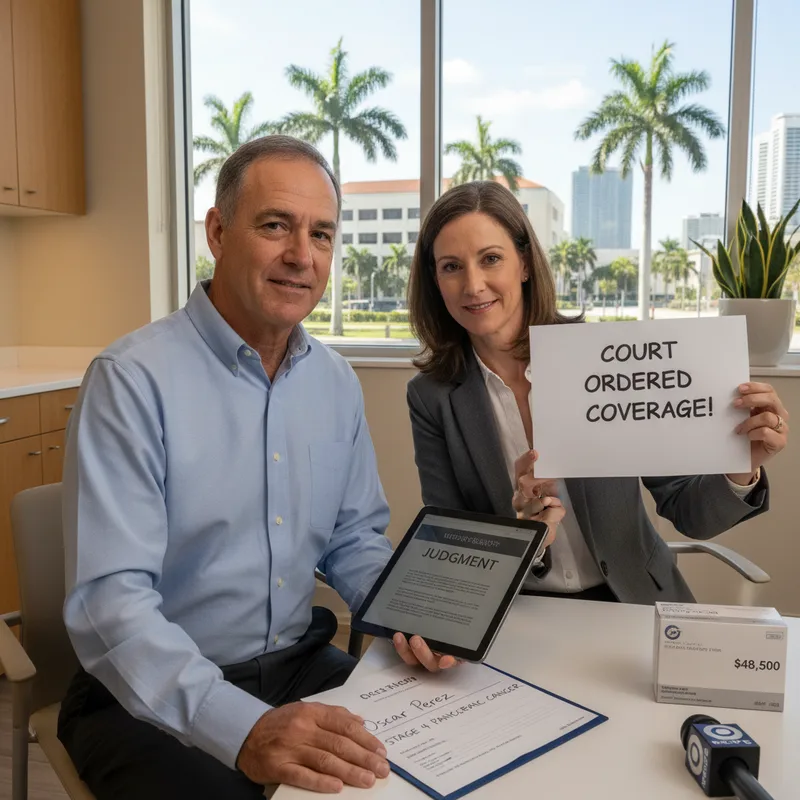
A Miami man battling advanced pancreatic cancer has won a significant legal victory against his health insurer, Oscar Health. In a decision that could have wide-ranging implications for patients in similar situations, a Miami-Dade Circuit Court judge has ordered the insurance giant to authorize and pay for a recurring $48,500 drug treatment prescribed by his doctor.
The ruling, delivered by Judge Migna Sanchez-Llorens on Thursday, marks a pivotal moment for Pablo Langesfeld, who has been fighting for coverage since December. Langesfeld is also a familiar name in Miami, having lost his daughter and son-in-law in the tragic 2021 Champlain Towers South collapse in Surfside.
Speaking to reporters outside the Osvaldo N. Soto Miami-Dade Justice Center on Friday, Langesfeld’s son, Martin, described the ordeal as an “extremely intense and painful battle.” The family expressed hope that their fight would pave the way for others facing denials from insurance providers for life-saving treatments.
A contentious denial
The dispute began late last year after Mr. Langesfeld’s chemotherapy treatments proved unsuccessful against his Stage 4 pancreatic cancer. His doctor prescribed Avmapki Fakzynja Co Pack, an oral medication that has shown considerable promise in treating certain types of cancer.
No sick person in the hardest moment of their life should have to stand and fight in a courtroom with lawyers for their life,
Oscar Health repeatedly denied coverage for the expensive drug therapy. The insurer argued that the medication was not “medically necessary” and, crucially, that it was not federally approved by the U.S. Food and Drug Administration (FDA) for treating pancreatic cancer. This practice, known as 'off-label' prescribing, is a common and legal part of modern medicine, particularly in oncology. In related matters, the Supreme Court is weighing police use of Google location data. According to the National Cancer Institute, many drugs found to be effective against one type of cancer can also be used to treat others. Because of the vast number of possible drug combinations, the FDA does not typically approve specific chemotherapy combinations, leaving prescribing decisions to the discretion of medical professionals based on their patients' needs and the latest research
The promise of an orphan drug
The drug at the center of the case, Avmapki Fakzynja Co Pack, is FDA-approved for treating ovarian cancer. However, its potential for fighting other malignancies is under active investigation. In 2024, the FDA granted it an “orphan drug” designation to encourage further research into its effectiveness against pancreatic cancer.
The Orphan Drug Act provides incentives for pharmaceutical companies to develop treatments for rare diseases, defined as those affecting fewer than 200,000 people in the United States. Pancreatic cancer is the third-leading cause of cancer-related deaths in the country, but specific mutations and advanced cases can make certain patient populations eligible for these targeted therapies.
For Langesfeld, the prescription represented a crucial lifeline after other treatments had failed. His legal team successfully argued that the denial of coverage for a physician-recommended, FDA-designated drug was unjust, leading to Judge Sanchez-Llorens’s order compelling Oscar Health to pay.
A
'flawed' system
Martin Langesfeld described the American healthcare and health insurance systems as “flawed” and in desperate need of reform. His family’s struggle highlights a frequent battleground between patients and insurers, where expensive but potentially life-saving treatments are denied based on contractual clauses and internal policy, often forcing patients into lengthy and stressful appeals processes or legal fights.
Patient advocates and legal experts say the Langesfeld ruling could serve as an important precedent. While not legally binding on other courts, it provides a powerful example for other patients who have been denied coverage for off-label drugs, especially those with an orphan drug designation. The case underscores the critical role of the courts in interpreting medical necessity and challenging insurers' decisions.
In a statement to the Miami Herald, Pablo Langesfeld emphasized that his fight was not just for himself. “This is not just about me, it’s about helping other people being able to get treatment,” he said.
Oscar Health and its attorneys have not publicly commented on the ruling. The company has 30 days to file an appeal against the court’s decision.